.svg)
Forest Management That Considers Both Nature and Long‑Term Asset Value
The utilization of forest resources involves many kinds of values, expectations and decisions. On some sites, decisions may focus more on timber production, while on others entirely different aspects become the priority. For the forest professionals at Skogssällskapet Finland, however, the final decision-maker is always the forest owner.
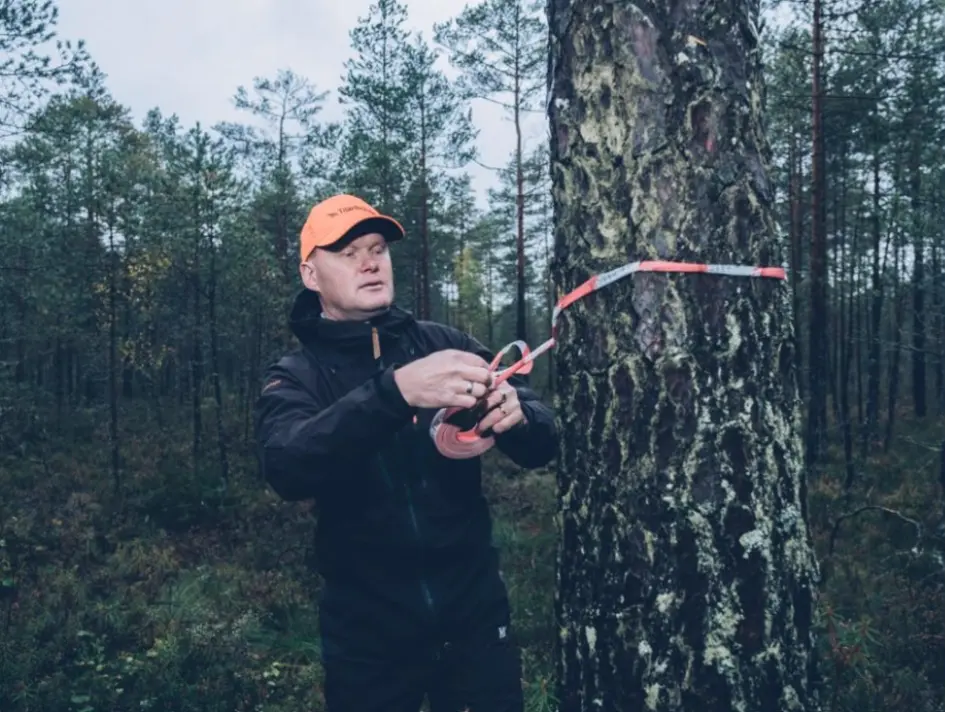
Forest manager Kristian Kuokkanen serves his clients in the Helsinki metropolitan area, covering a region whose western edge is in Raasepori, northern boundary around the Hyvinkää–Riihimäki area, and easternmost forest estates in Loviisa.
“Sometimes we work very close to residential areas, but my region also includes traditional countryside. Important stakeholders include, for example, the Finnish Forest Centre, the Regional State Administrative Agency, and through zoning processes, municipalities and cities. Near residential areas it’s important that we inform residents of upcoming work and pay special attention to landscape considerations,” says Kuokkanen, who has worked over 30 years in the forest sector.
Siv Vesterlund-Karlsson has been with Skogssällskapet for a year, but she also has a long background working for various employers. Her clients’ forest estates are mainly located in the archipelago of Southwest Finland, within the municipality of Kimitoön and the city of Parainen.
“The archipelago is a varied place to work and grow forests,” says Vesterlund-Karlsson, who also lives on Kimitoön. “The sea is always present, and water protection is especially important. The quality of timber here in the archipelago is also different from the mainland.”
Both forest managers describe themselves as nature-oriented people. Considering nature values and biodiversity is a natural part of their work.
“I work in and with nature. Forests generate the best income when we do good for nature. We are constantly gaining more knowledge about issues related to nature and water protection,” Vesterlund-Karlsson says.
Information from Many Sources
Skogssällskapet’s forest managers have a wide range of tools that they use to access the most up-to-date nature information when planning forestry work.
“Forest management plans provide a good foundation on what valuable features exist in a forest. Municipalities and cities today have excellent map systems that also include various nature sites. When I submit a forest use declaration to the Forest Centre, I often receive information on special species found at the site. The flying squirrel is a good example, but it could just as well be a rare moss or lichen species,” Kuokkanen explains.
He actively uses the laji.fi species information service maintained by the Finnish Biodiversity Information Facility. There, one can explore species and their occurrence, browse recorded observations and enter one’s own. At the moment, the service includes over 50 million georeferenced observations of species from Finland and nearby regions, sourced from over 600 different contributors.
Local “silent” knowledge often provides irreplaceable additional insight to the nature surveys conducted on sites. For Vesterlund-Karlsson, important stakeholders include nature conservation associations, forest activists and other nature enthusiasts. Finding the best solutions requires cooperation and a willingness to seek compromises.
The Best Solutions Are Found Together
“Every situation is different, and there are diverse opinions. It’s important to listen to what others have to say,” she describes the social side of her work. “The fact that something has already been found on a site does not mean there couldn’t be more. Together with the forest owner we identify the most sensitive areas and consider how work can be carried out there.”
Combining different forest management and harvesting methods on varied sites is part of the forest managers’ everyday work. Vesterlund-Karlsson, who has also studied forestry in Germany, says mixed methods are her personal favorite. She has clients who no longer request any other harvesting method than continuous cover. She also praises the willingness of Skogssällskapet’s machine contractors to learn new things.
“Forest owner satisfaction is still the most important thing,” she summarizes. “Of course it feels good when you see results. Wetland construction is a good example of how biodiversity can quickly be increased in different areas.”
“Nature continues to teach and constantly surprise us,” adds Kuokkanen. “The finest site is one where I have been able to use my expertise and succeeded. That’s when it feels like I’ve earned my pay.”
Text: Martti Linna